Ann Foster was born in England in 1620 and was married before 1640 in America. George Kempe and Mary Hutchinson were also born in England and married there before coming to America.
Robert Berry of Orange County, NC, was an early pioneer in North Carolina and he was our Brick Wall for about 10 years. All of the information I have been able to find now indicates that Robert Berry (OC) was born in Princess Anne County, Virginia, and removed to Orange County, NC, sometime in 1751.
A few substantiating facts:
On Robert’s 1751 land grant entry he was named Robert Berry Jr. once.
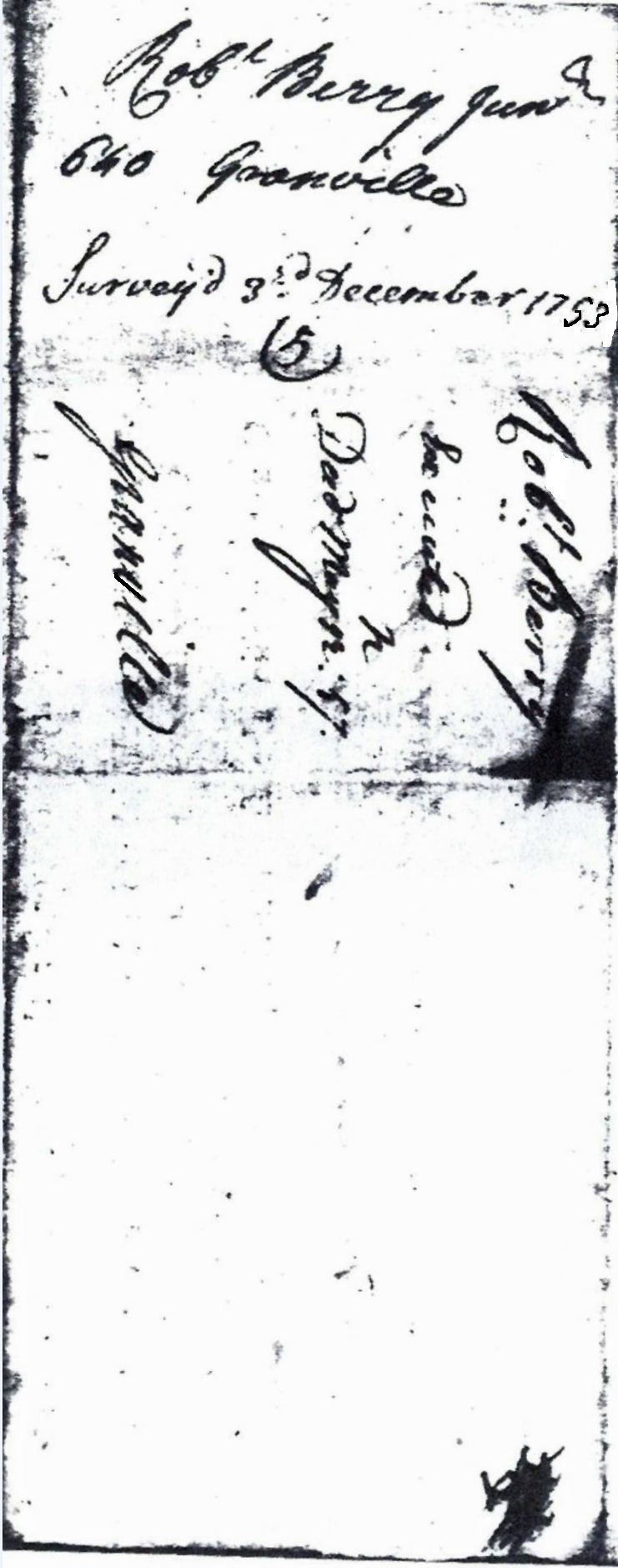
On Robert’s 1753 survey he was named Robert Berry Jr. twice.
On Robert’s 1757 land grant he was named Robert Berry Jr. five times and Robert Berry once.
Robert Berry who was born in Princess Anne County, Virginia, in 1729 was the son of Robert and Mary Williamson Berry.
Robert Berry born in 1729 was the grandson of Richard and Mary Kempe Williamson.
Robert Berry in Orange County, North Carolina, named his first daughter Mary and his first son Robert Berry Jr. This is a typical English naming pattern.
Robert Berry born in 1729 had an Aunt Sarah S. Williamson Mathias, wife of Matthew Mathias.
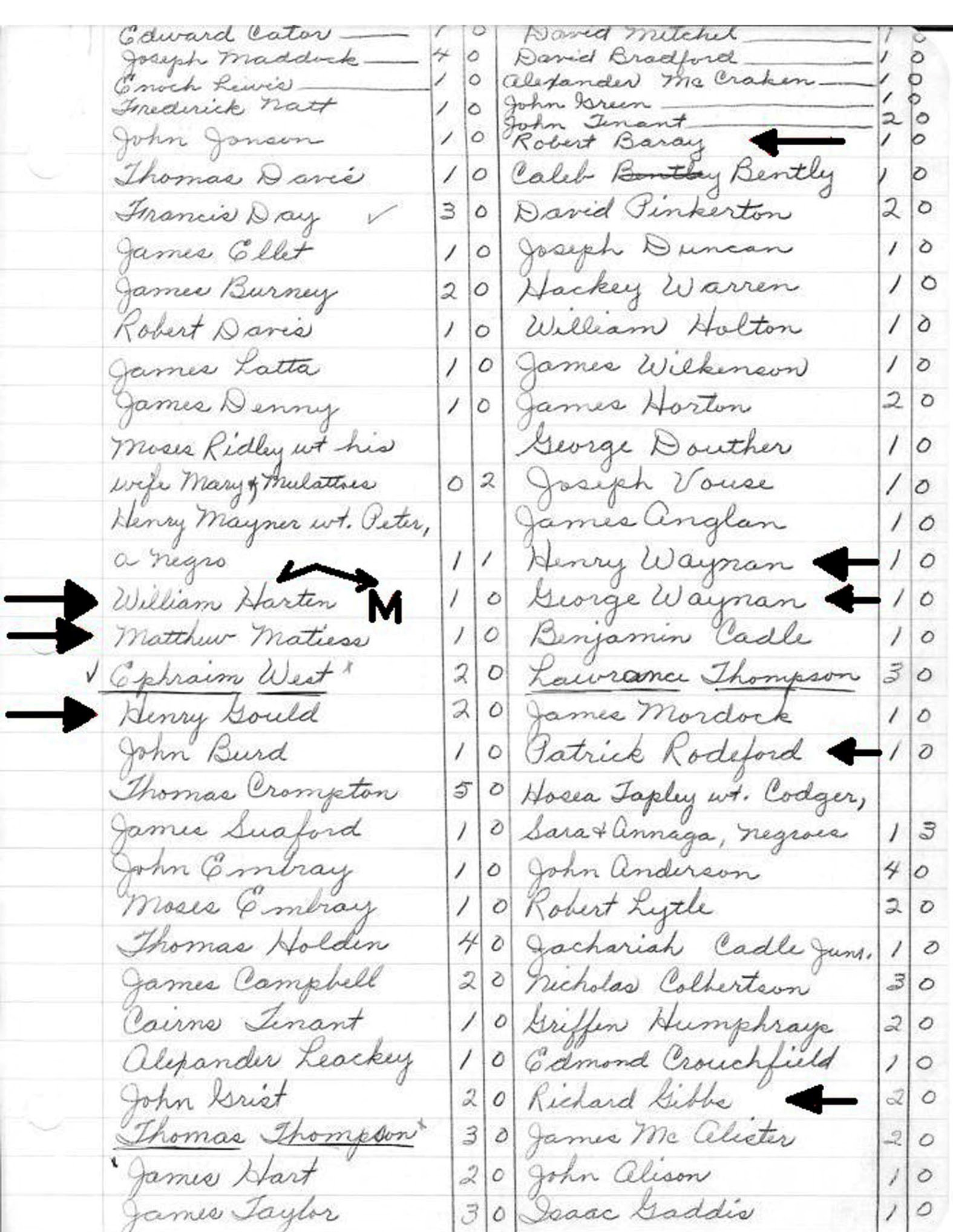
Robert Berry (OC) was listed a few farms away from Matthew Mathias in the 1755 Orange County Tax List.
Robert Berry born in 1729 inherited the family homeplace, and the Robert Berry who came to North Carolina in 1751 had money and was able to build a large Plantation Home there in 1766, only 15 years after arriving.
When Robert and Elizabeth Cate Berry named their first son Robert Berry Jr., his father was known as Robert Berry on every official document after his first son was born. The first daughter was named Mary, and her grandmother was Mary Williamson Berry and her great-grandmother was named Mary Kempe Williamson. The second daughter was named Elizabeth Berry for her mother. Her maternal grandmother’s name, Margery, had already been taken — her mother’s sister was Margery Pryor.
There is a common English naming pattern that has been followed by our Berry Family. When a son is named Junior, the father drops the Junior prefix from his own name. The father is either known without a prefix at all, or Sr. is added to his name.
After finding Robert Berry in Princess Anne County, Virginia, with a son named Robert who was born in 1729, I was convinced that Robert Berry (OC) was born in Princess Anne County, Virginia. It cleared up the problem I had been having with the Entry, Survey, and the Granville Land Grant where Robert Berry Jr. was named on all three of these documents. I had always wondered why he was known as Robert Berry on every document after the Grant was made. It was the naming of his son Robert Berry Jr. in 1760 that had changed this.
Robert Berry (PAC) 1670–1730, Princess Anne County
Robert Berry (OC) 1729–1814, Orange County
Robert Berry Jr. 1760–1841/1849, born in Orange County NC, died in Fayette, Alabama
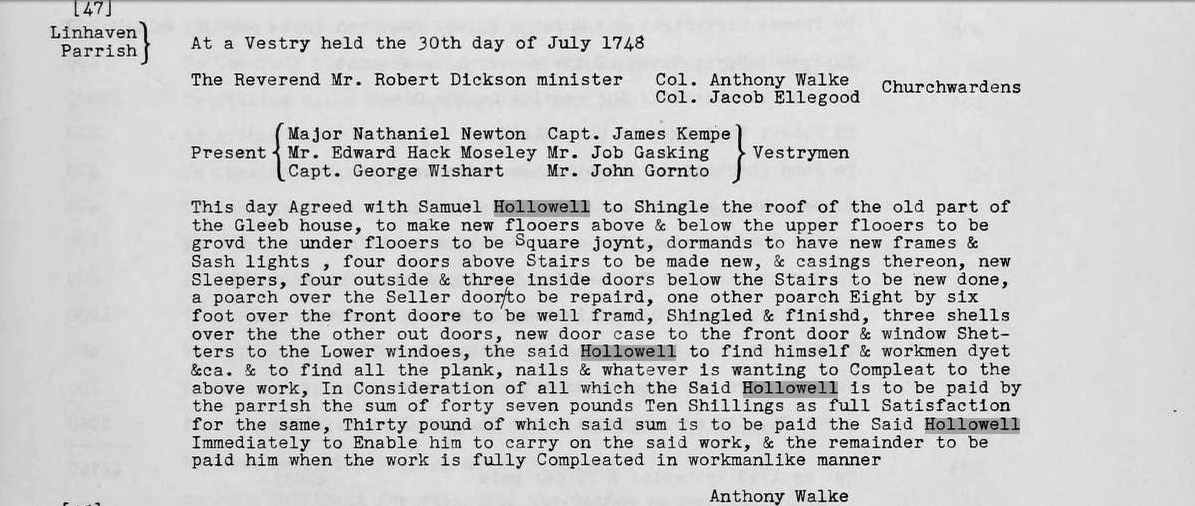
Robert Berry (OC) was born in Princess Anne County, Virginia. His father died in 1730 when he was very young, and his mother died in 1746 when he was about 17 years old. At 17 years old he had the courts indenture him to a family member, Samuel Hollowell, to learn the carpenter trade.
Source: Vestry Book of Lynnhaven Parish, Princess Anne County, Virginia, page 72. Robert Berry born in 1729 was indentured to Samuel Hollowell at the time this Church Contract was issued, and there is a very good likelihood that our ancestor worked on this project.
In 1751 Robert and his cousin Matthew Mathias, and likely others, decided to remove to Orange County, North Carolina, to stake out land as planters. John Cate and his two sons were also probably in this group since one of John’s sons, Thomas Cate, was a chain carrier on Robert’s 1753 survey.
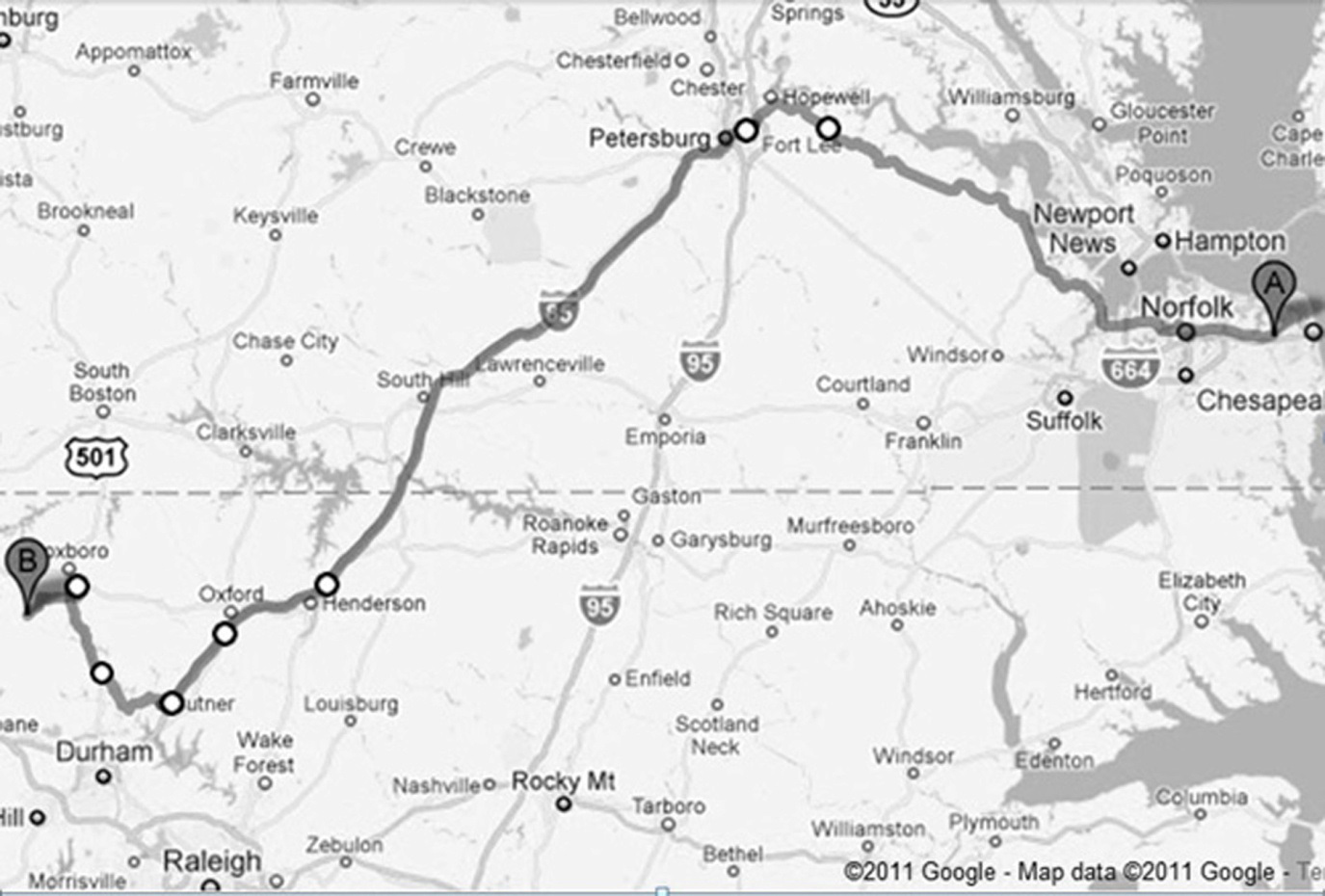
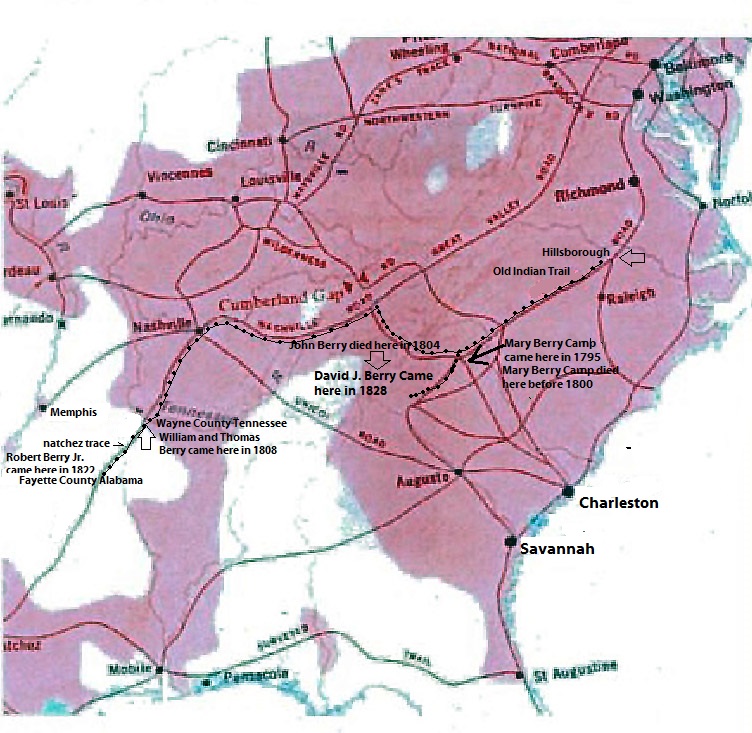
The most obvious route from point A to point B
This route was being used by fur traders for as many as 50 years before our Robert Berry entered North Carolina. John Lawson met a pack mule train on this same trail in 1704. He was headed toward Hillsborough from the southwest when he encountered them and exchanged a friendly conversation that morning. The drover allowed that he was born in England and that the land was the most beautiful that they had ever seen.
Fortunately Robert had some money from the estate that his father left him. Robert located some unclaimed land just south of property owned by Thomas Bradford in Granville County. Robert built a small cabin in the northeast corner of his newly claimed property. He and Matthew may have lived there for a time. After completing the cabin, Robert Berry (OC) walked into the Granville Land Grant Office and made entry for a land grant on the sixth day of February 1752. This was the first step to becoming the proud owner of a large tract of land in Granville County. The warrant was granted on the 20th Day of March 1753.
This was about as far into the wilderness as western man had settled at that time. Later in 1752 the government in Edenton decided to take part of western Granville County along with parts of Johnston and Bladen to form a new county of Orange. Since Robert placed his entry in Granville County and the warrant was issued there, both documents were not found in the Granville County files until 2007. The survey and Granville Land Grant documents were found many years ago in the Orange County, NC, files.
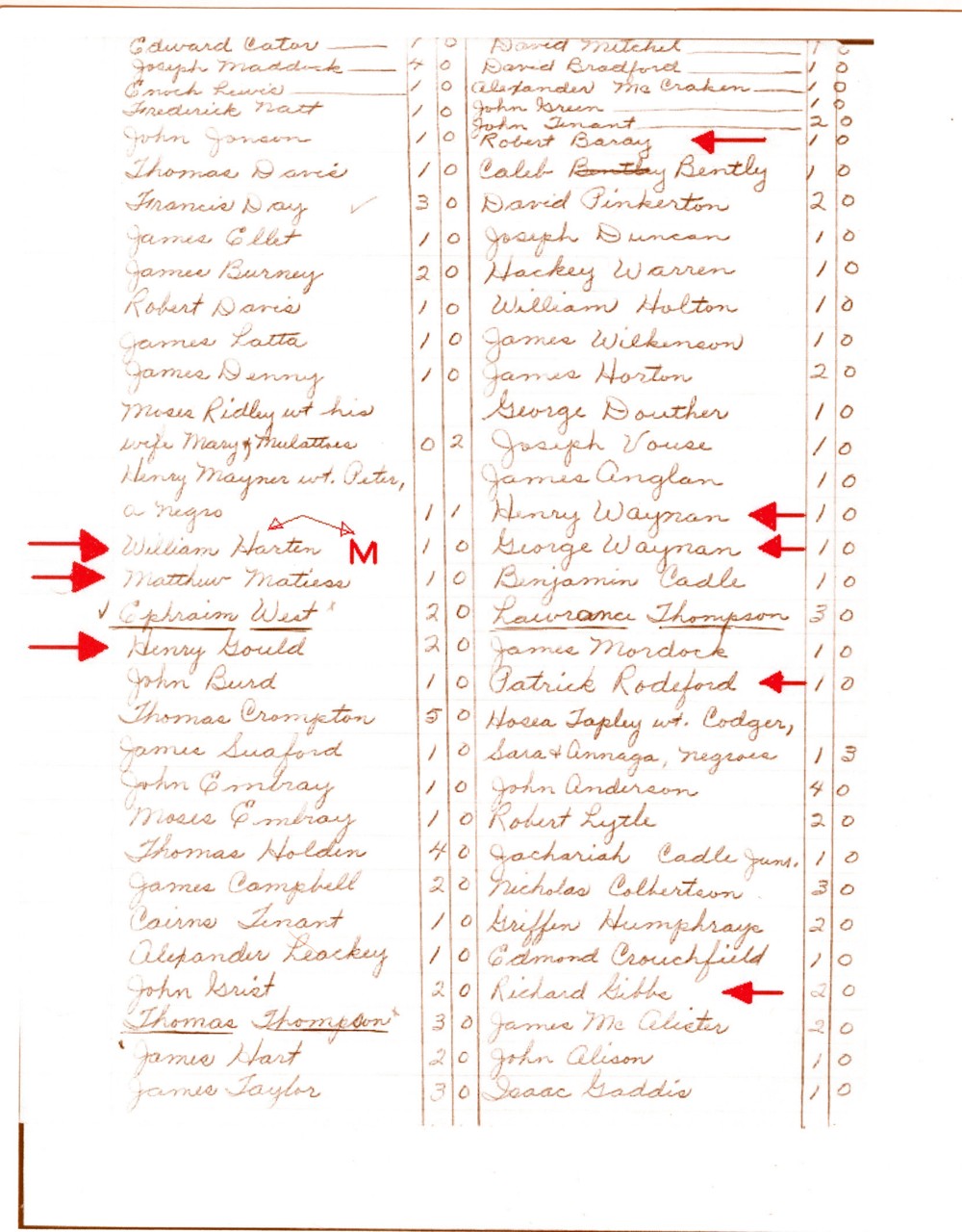
Page 5 of the 1755 Orange County, North Carolina, Tax List. Both Robert Berry and Matthew Mathias were listed on the same page. Henry (Gold) Gould, one of Robert Berry’s survey chain carriers, is listed two households away from Matthew Mathias.
Richard Gibbs was sued by Robert Berry and was also listed on the same 1755 tax page as Robert Berry.
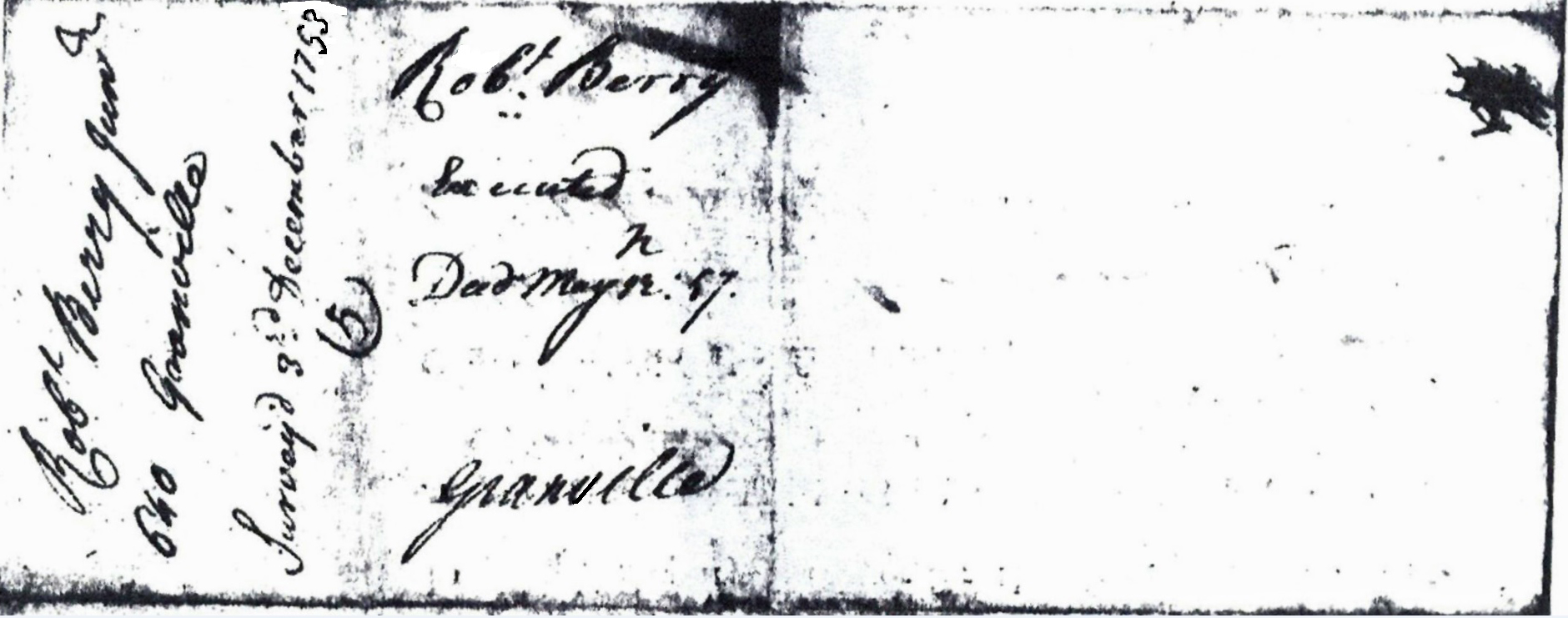
1753 Survey Order and date deeded to Robert Berry Jr.
As you can see, Robert Berry was listed on the back of this deed as Robert Berry Jun. This means that he had no son named Robert in 1757 and his father’s name was Robert Berry. Once Robert and Elizabeth Cate Berry named their first son Robert Berry Jr., Robert Berry (OC) became Robert Berry Sr. All official documents that were signed after 1760 were signed by Robert as Robert Berry, and he never used the Sr. or the Jr. prefix again.
The fact that Robert and Elizabeth Cate Berry named their first daughter Mary indicates that her paternal grandmother was named Mary. Mary Williamson was Robert Berry’s wife in Princess Anne County, Virginia, and they also had a son named Robert who was born in 1729. These facts were my first clue that Robert Berry who came to Orange County, North Carolina, in 1751 was the son of Robert and Mary Williamson Berry from Princess Anne County, Virginia. There are many other facts that finally broke down my brick wall that have now been found.
View Warrant — The survey was not done until December the 3rd 1753, almost two years after the warrant was issued.
William Churton signed the survey and the chain carriers were Henry Gold and Thomas Cate. Thomas was the youngest brother of Elizabeth Cate, the future bride of young Robert Berry. Nobody knows exactly when Robert and Elizabeth were married, but from the ages of their children one can presume it was around 1759. The Granville Grant was issued on May 12, 1757, in Orange County, NC.
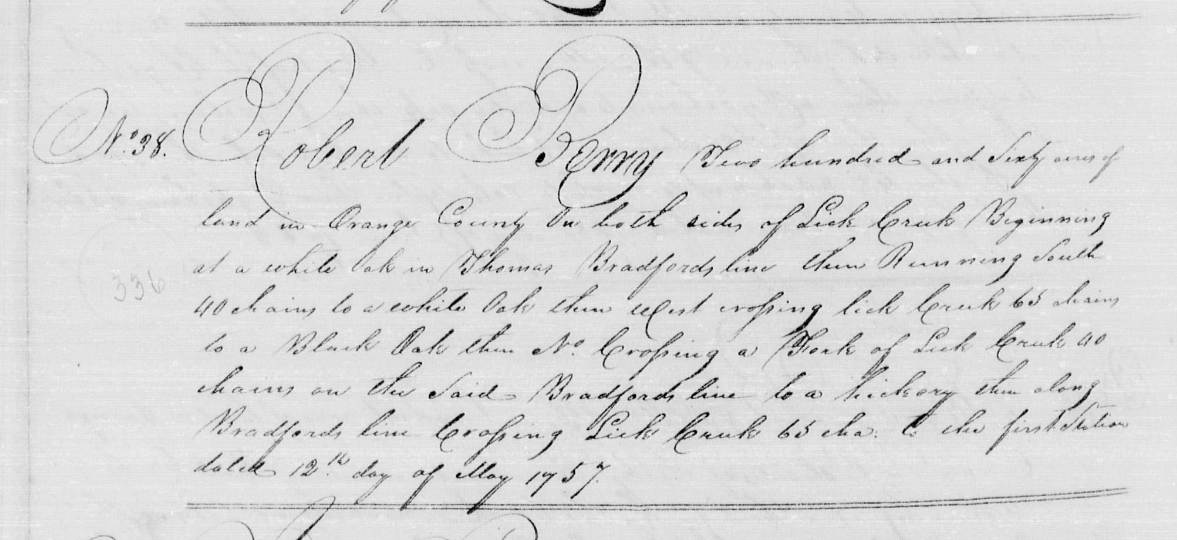
The 1757 Granville Land Grant — Patent Book Record#
Patent Book 14, page 334 — Grant No. 38, File No. 336. The Granville Grant to Robert Berry, dated 12 May 1757, in his own words: “Two hundred and Sixty acres of land in Orange County on both sides of Lick Creek, Beginning at a white Oak in Thomas Bradford’s line, then Running South 40 chains to a white Oak, then West crossing Lick Creek 65 chains to a Black Oak, then North Crossing a fork of Lick Creek 40 chains on the said Bradford’s line to a hickory, then along Bradford’s line Crossing Lick Creek 65 cha: to the first station.”
Citation: State Archives of North Carolina, MARS database, via NC Land Grants Images and Data (nclandgrants.com) — Grant No. 38, Patent Book 14 page 334, File No. 336, Box SSLG 84F, MARS 12.13.84.22 / 12.14.95.333. https://nclandgrants.com/grant/?mars=12.14.95.333&qid=1328841&rn=1
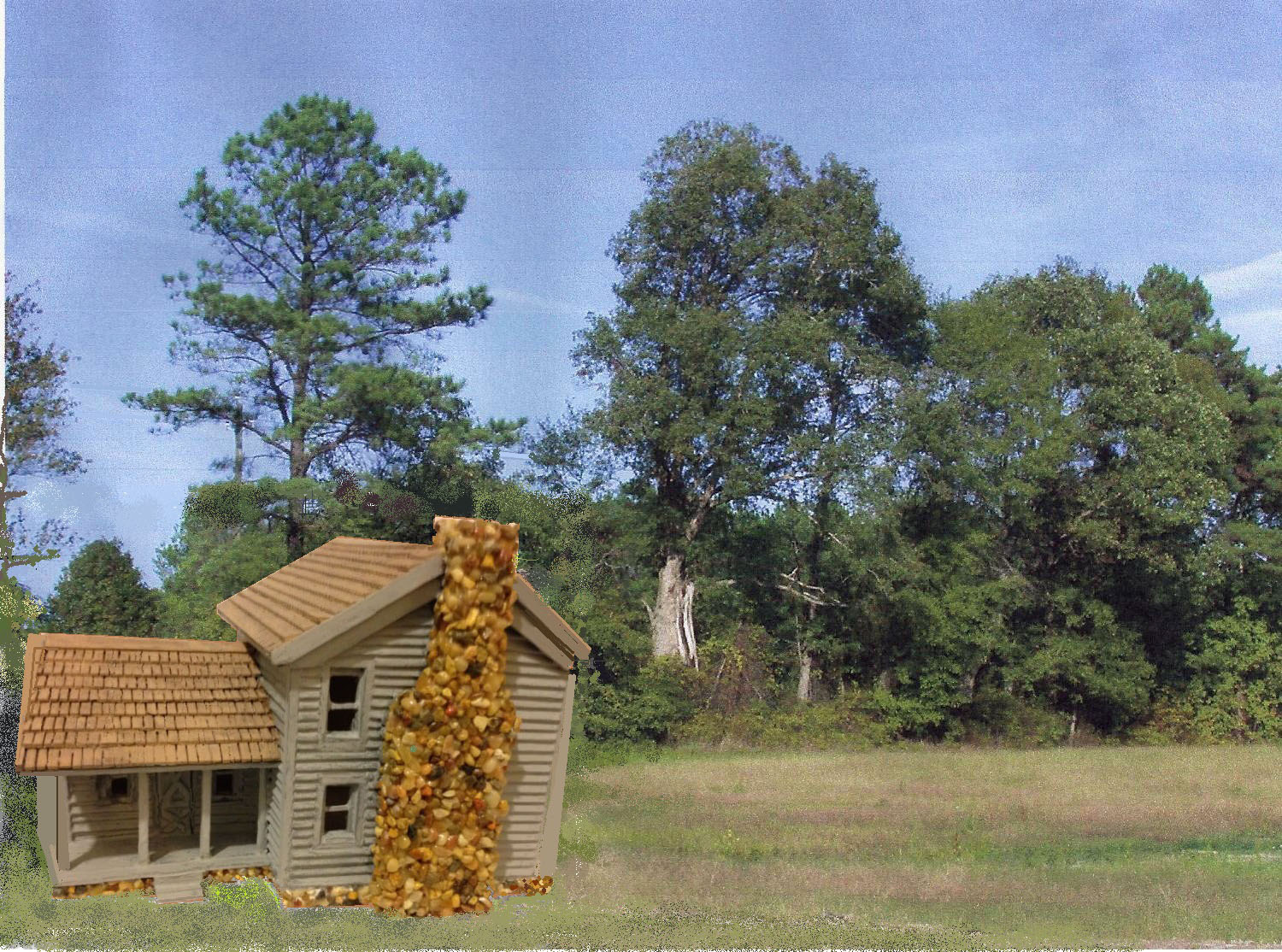
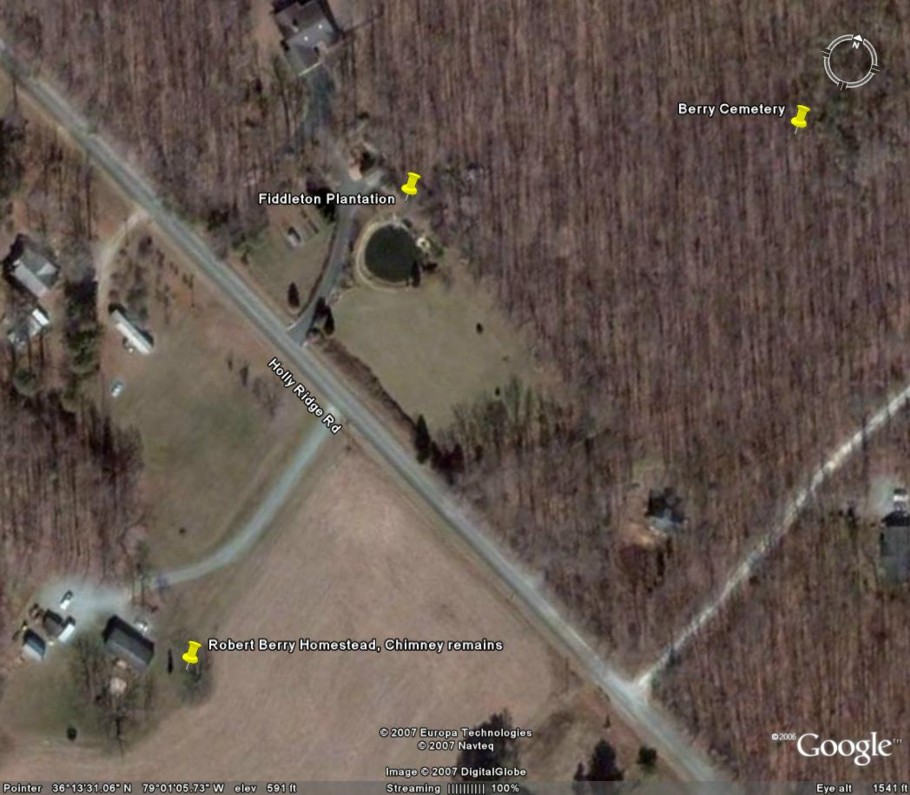
Both the land grant and the survey were found in Orange County Records about ten years ago. Remains of a foundation of a cabin was located on Fiddleton property about two years ago, and the chimney, which is all that is left of the Plantation Home, was found in February 2007.
GPS location of the chimney:
Latitude: N 36.22373 (N 36° 13’ 25.4")
Longitude: W 79.01882 (W 79° 01’ 7.8")
The location of the Plantation House, which was built in 1766, was about 200 yards from the southern boundary on the original grant property and about 200 yards east of Lick Creek.
Location of the Fiddleton Plantation, Robert Berry family home place and cemetery
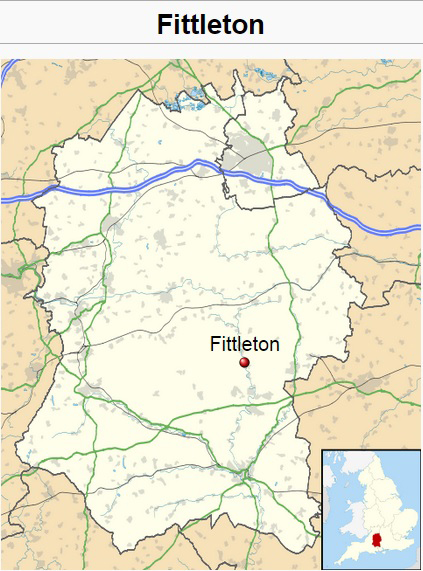
A map of Fittleton, Wiltshire County, England. The names Fiddleton and Fittleton are so similar that it seems to be very strong proof that Robert Berry in Orange County had Berry ancestors who lived in Fittleton, Wiltshire County, England.
Robert Berry was a great business person, which is substantiated by the fact that he accumulated about 1,002.25 acres of land in his lifetime:
Original Granville Land Grant for 260 acres on December 3, 1753.
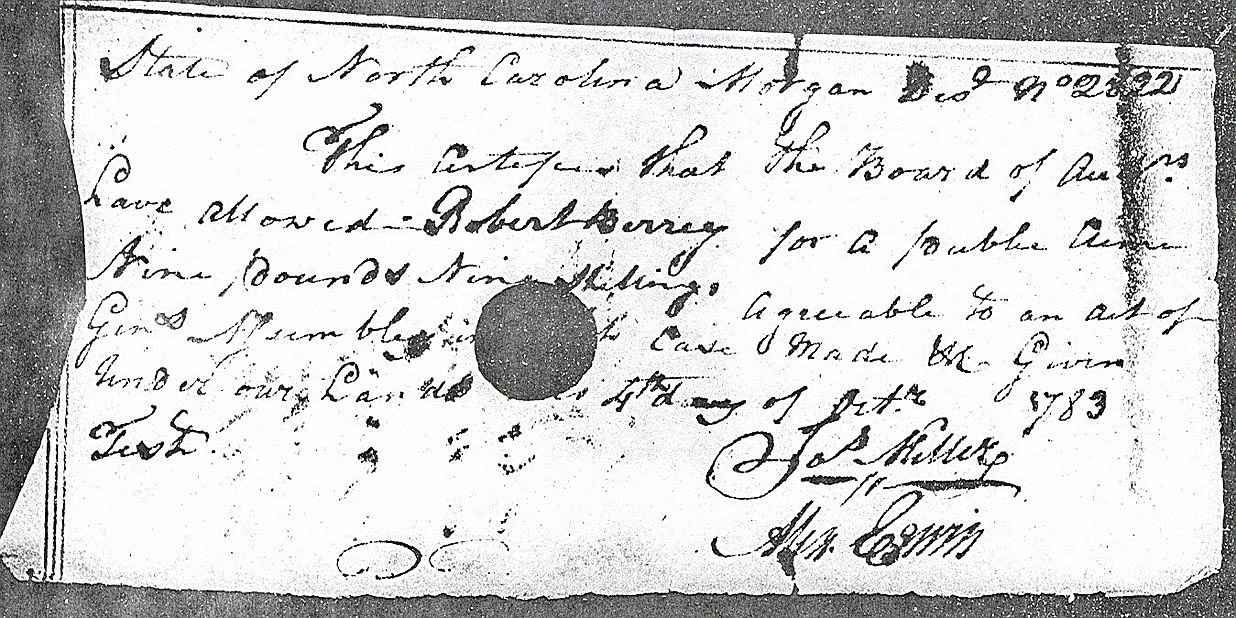
In 1785 he purchased 200 acres from John McCullough for 25 pounds 4 shillings Proclamation Money.
In 1787 he purchased the Patrick Rutherford property of 247.25 acres adjoining the southern boundary of the land grant property from Patrick’s three sons, William, James, and Thomas Rutherford. Orange County Deed Book 4, Page 518.
Robert Berry was granted another 293 acres of land adjoining his east boundary on March 13, 1780. Orange County Deed Book 42, Page 19.
Sometime soon after settling, Robert Berry (OC) married Elizabeth Cate, daughter of John and Margery Cate, and around 1758/1759 their first child Mary Berry was born. Over the next 18 years there was a total of ten children born and raised to adulthood by this union.
Robert Berry wrote his will on April 16, 1812 (Will Book D, page 408). Robert Berry was likely the first person to be buried in the Fiddleton Cemetery, which is located very near the center of his 1757 Granville Land Grant property. There are 23 graves in this cemetery, which was not discovered until 2005.
In my research I have become to know a lot about the man, our Robert Berry, who made a life for himself and his family in Orange County, North Carolina. Robert had a very good start in life when he inherited the property in Princess Anne County, Virginia, from his father’s will.
Robert Berry allowed his daughter Elizabeth Berry to live in his home until his granddaughter Mary Berry (born out of wedlock) was grown and married. This may have been because Elizabeth was raped, but in those times some families would not have allowed this even under those circumstances.
Things had gone well for Robert by the time he built his plantation house. The French and Indian War was not a factor to Orange County settlers, but other things were going on in Orange County that would have a major effect on the settlers’ loyalty to the Crown. The Tax Collectors in Orange County were starting to cause some problems for the plantation owners and farmers. The tax rates were not extreme and the local farmers managed to pay them most of the time. The problem came when the Sheriff and other officials started getting greedy and only sending about half of what they were collecting to Newbern. Governor Tryon had some elaborate plans to build a new Palace in Newbern to be used as the governor’s mansion. Since the tax money was not coming in as it should, the governor and the legislature decided to raise taxes. This did not set well with the hard working men in the back country. A lot of their income was in the form of goods and materials accumulated by bartering. Real hard cash was very scarce and paying the taxes that were already levied could be difficult.
In 1768 there was a Regulator organization formed in Orange County. Their motive was to try to get a just and peaceful resolution to the dishonest practices of the local officials. Governor Tryon heard the delegation on several occasions when they went to Newbern and he promised each time to correct the abuse of power. Of course nothing was ever done. Robert must have discussed these problems with his neighbors Thomas Rountree, Richard Holeman, Archileous Wilson, Patrick Rutherford, George Waggoner, Henry Waggoner, and his father-in-law John Cate.
Nobody knows for sure which men were involved in this movement because when Governor Tryon marched from Newbern and attacked the ill-prepared Regulators in the Battle of Alamance, with his well-trained army, the Regulators did not have a chance. Many of the Regulators recognized the futility of their efforts. They simply melted away into the woods and went back home. Tryon captured a few unfortunate settlers and hanged three at the Hillsborough Courthouse and had the others sign a pledge of allegiance to the Crown and dissolved the Regulator movement. Many historians believe this was the first battle of the Revolutionary War. This may not be true, but I am sure that Robert Berry could see that the English rule was not going to be just and fair after the Battle of Alamance and the treatment of the captured Regulators. After the way Governor Tryon handled their legitimate complaints, I suspect Robert Berry felt little less need to support the Crown.
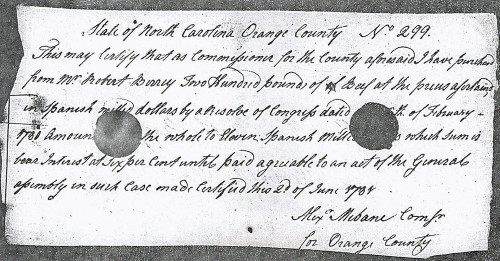
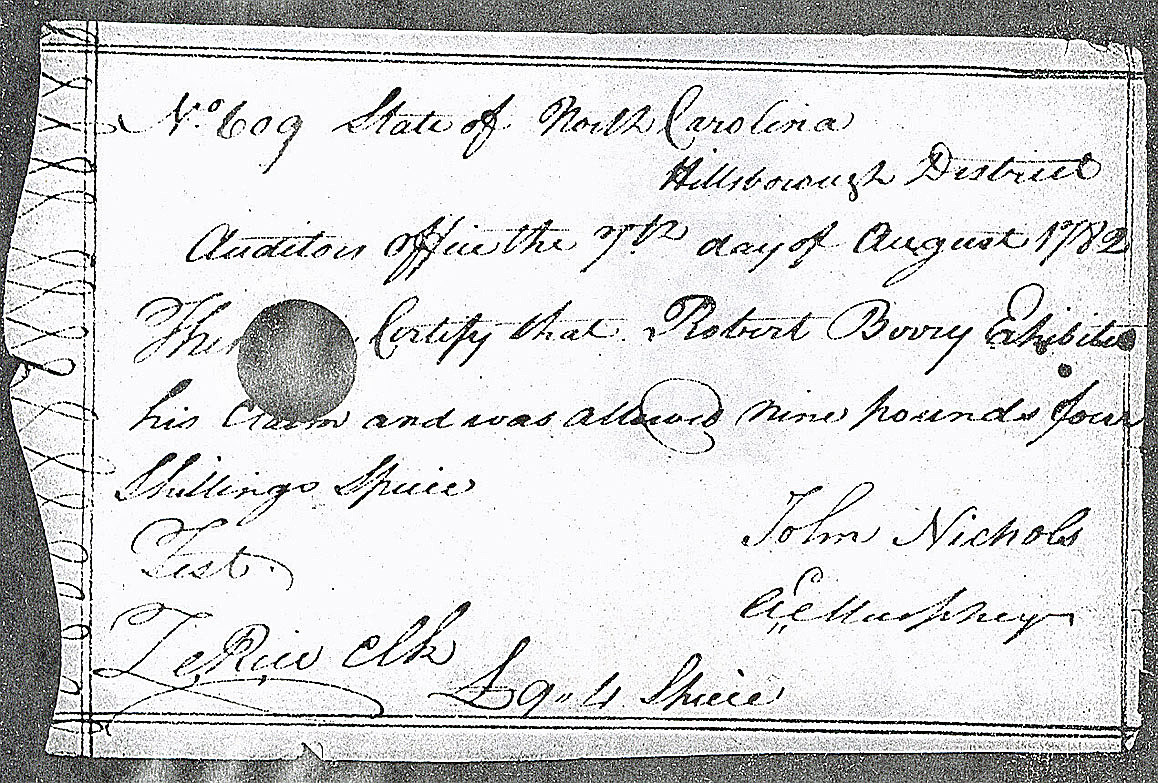
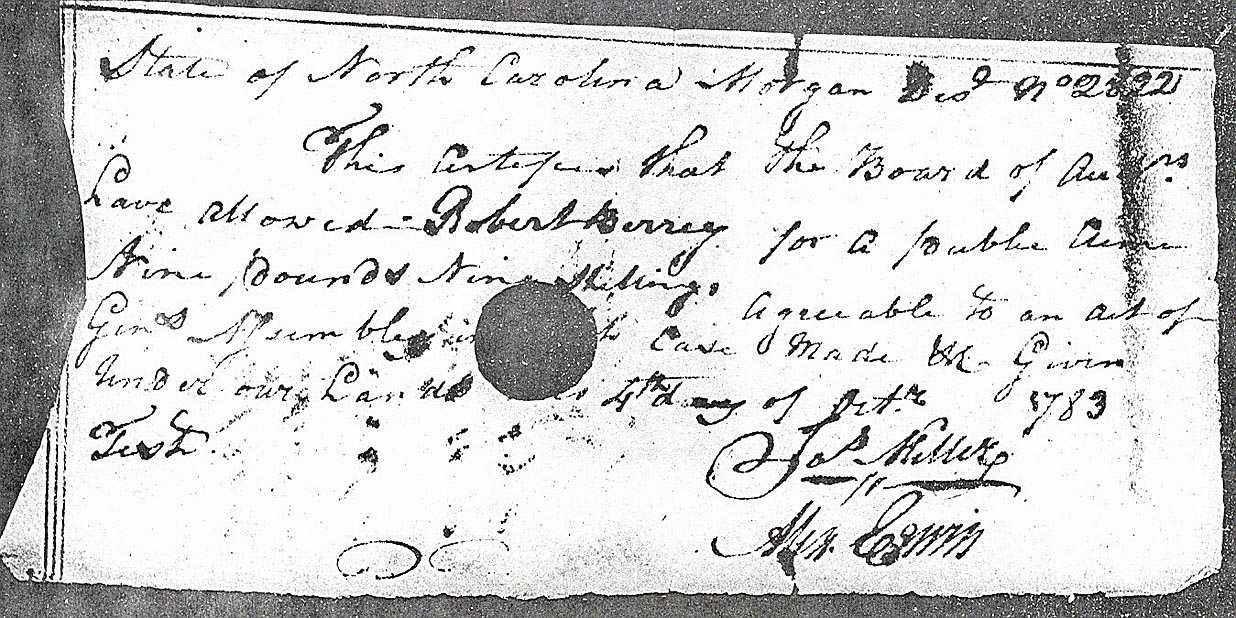
The events to follow demanded that each settler make up his mind which side of the war they would choose to support. On October 7th, 1780, the Continental Army defeated the British Army decisively at Kings Mountain, North Carolina. Robert Berry must have been well aware that it was only a matter of time before Cornwallis and his army would be marching to Hillsborough to take over that very important city. I know he was supporting the patriots because he sold some beef to the Continental Army. I am sure he had made up his mind well before the war actually came to the local area.
On March 15th, 1781, the Battle of Guilford Courthouse was fought, and Cornwallis claimed the victory, but the war was lost at that battle. Officially the Battle at Yorktown brought the Revolutionary War to an end about six months later. Cornwallis was kept on the run after Guilford Courthouse and was having supply problems. I think Robert Berry only fought in the Guilford Courthouse Battle. I think his son-in-law George Waggoner was severely wounded in that battle and died about a month later.
Cornwallis had expected the Loyalists to swell his army as he penetrated the state from the south. This did not happen. The backwoods farmers and planters had experienced real freedom and independence for as much as 20 to 30 years. I think the English completely overlooked that fact and were completely surprised by the disloyal attitude of these settlers. We as Robert Berry descendants can be very proud of our ancestor who helped our nation get its start.
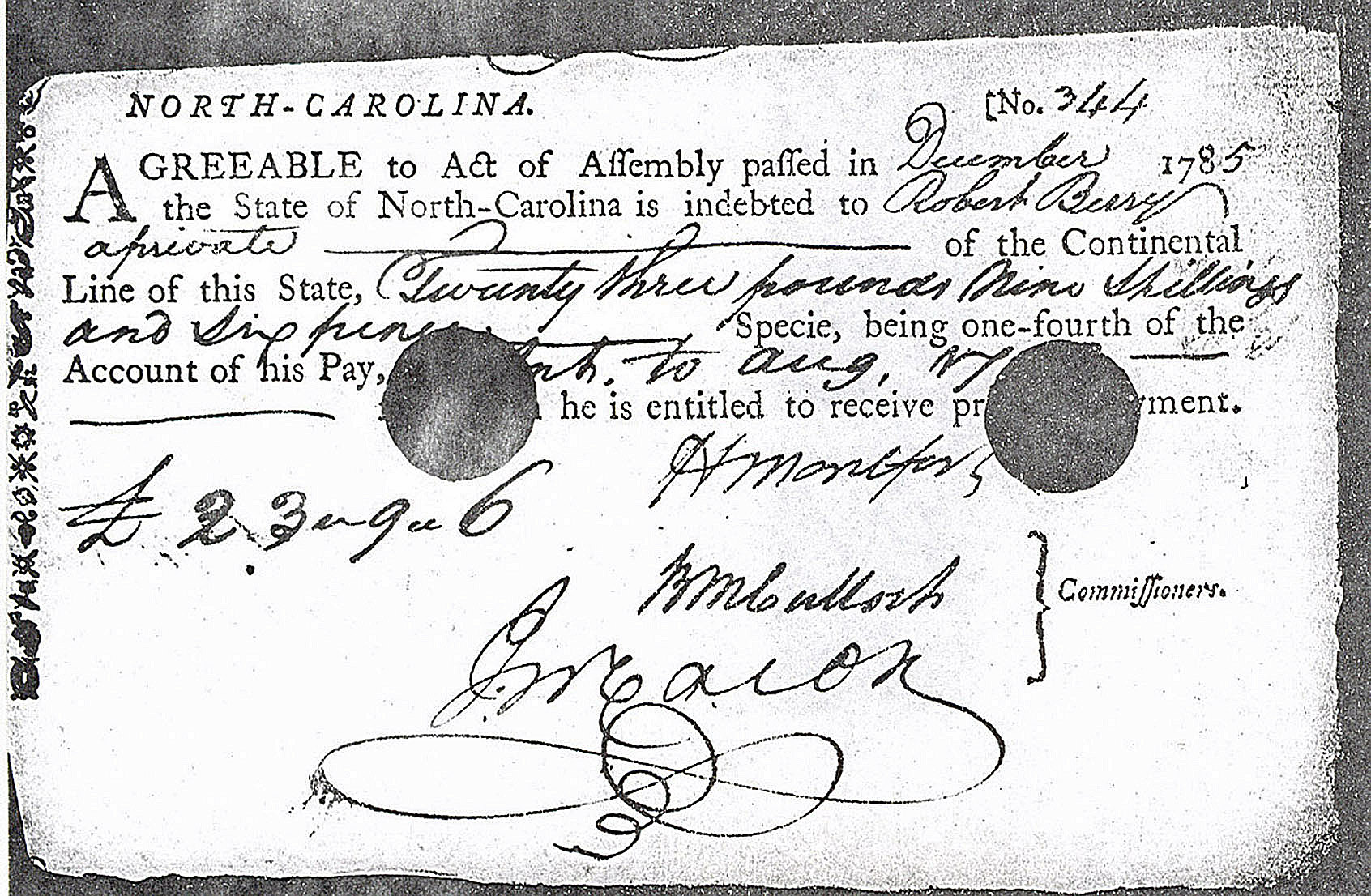
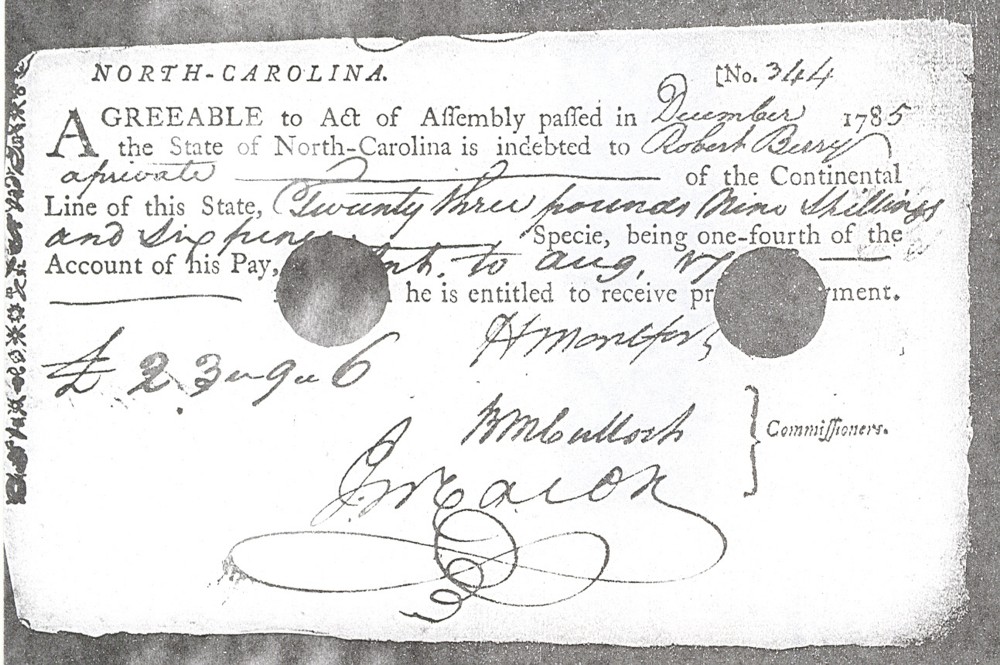
Robert Berry served as a Private in the North Carolina Continental Line.
Alex Mebane was the Orange County comptroller representing the Continental Army. He purchased 200 pounds of beef from our ancestor, Robert Berry.
General Nathaniel Greene was acquiring food for his army, and by using up all of the available food before General Cornwallis entered North Carolina, made it very difficult for the British General to feed his army. This was probably a factor in the General departing our state as quickly as he did after his dubious victory in Greensboro. The Battle of Guilford Courthouse was fought on March 15, 1781. General Cornwallis lost a lot of men at that battle, and the British statesman Charles James Fox (1749–1806) said of this result: “Another such victory would ruin the British army.”
I have heard that after the battle was over, General Greene retreated across the Dan River into Virginia. When his army reached the spring-flooded river, Greene confiscated all of the available boats to ferry his troops to the other side. When the British army got there they had no way to follow Greene’s Army. After this, General Greene continued chasing General Cornwallis around North Carolina until they left our state. Seven months and four days after the Battle of Guilford Courthouse, the British army surrendered at Yorktown on October 19, 1781.
Robert Berry was a very civic-minded citizen. His civic duties included serving on jury duty, chain carrier during surveys to locate roads, serving on road building crews as a worker and as the overseer as many as three times, and serving as a private in the Continental Army.
The following court records document his involvement in local affairs:
1777, November — The court session ordered that Robert Berry and his neighbors work on the road under Thomas Rountree. These men, including James Allison, William McKee, James Murdock, Moses Gwin, William Robinson, William Armstrong, and others, were all neighbors and friends of our Robert Berry.
1778, February — Robert Berry served on the Grand Jury alongside Samuel Allen (foreman), John Dickey, Robert Anderson, James Murdock, William Robinson, Hugh Finley, William Armstrong, Henry Waggoner, and others.
1782, May — Robert Berry is excused from attending as Juror at this Court, he having shown sufficient reasons. (He was likely serving in the Continental Army at this time.)
1784, May — Robert Berry is appointed Overseer of the road in the room of James Murdock.
1786, August — Michael Robinson is appointed Overseer of the road in the room of Robert Berry, from Caswell line to the South Fork of Little River.
1789, August — Robert Berry is appointed overseer of road in the room of T. Bowles.
1791, May — Wm. Jamison vs. Robert Berry, Certiorari. Jury found verdict for Plaintiff for £1:4:9 and costs.
1791, November — Administration of the estate of James Waggoner is granted to Catherine Waggoner. She entered into bond with Robert Berry Jr. as security in the sum of £50.
1791, November — Robert Berry served on a jury in the case of Thomas Burks’ Executors vs. George Doherty and William Mebane. The jury assessed the plaintiff’s damages at £12:4:10 and costs.
1791, November — The execution of a deed from William, James, and Thomas Rutherford to Robert Berry was duly acknowledged in open court by Joseph Taylor, Esq., and ordered to be registered.
Robert Berry’s older brother Richard Berry married Catherine. The deed book listing below proves the given name of Richard Berry’s wife and that he was still in Princess Anne County, Virginia, on January 10, 1787 — eleven years after we became independent from England.
BERRY, Richard and his wife Catherine to Mark Moore, dated 10 January 1787; for £100, 50 acres adjoining the lands of Tully Barnes, Charles Whitehurst and John Kenion; signed by Richard Berry (his mark) and Katherine Berry (her mark), witnessed by John Ackiss, Tully Moseley, Joshua Whitehurst and Jonathan Roberts; recorded 13 April 1787, DB20: 166.
BERRY, Richard and his wife Catherine to Tully Barnes, dated 10 August 1786; for £18, 15 acres adjoining lands of George Batten and Tully Moseley; DB20: 172.
We have a lot of well-documented information about Robert Berry in Princess Anne County, Virginia, and his son Robert Berry who lived most of his life in Orange County, North Carolina. We have very little information on Robert Berry’s other son Richard Berry. If anybody knows about Richard Berry’s family who may have lived in Princess Anne County, Virginia, or elsewhere, please contact us.
We located a Richard Berry who died in Chatham County, North Carolina, in 1774, but one male Berry who has a fairly good paper trail back to this Richard Berry took a Y-DNA test which does not match our family Y-DNA. We were excited when we found this document because Chatham County was formed from part of the original Orange County where Robert Berry was living at the time.
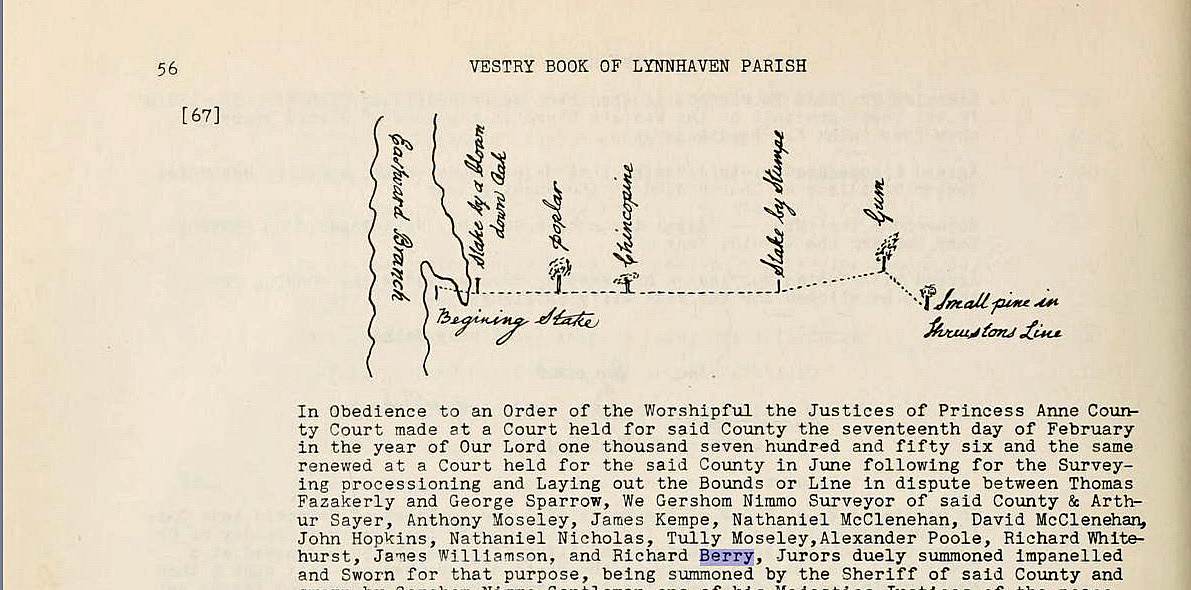
The document listed below proves that Richard Berry was still in Princess Anne County, Virginia, on February 17, 1756.
Document proving Richard Berry was in Princess Anne County, Virginia, on February 17, 1756
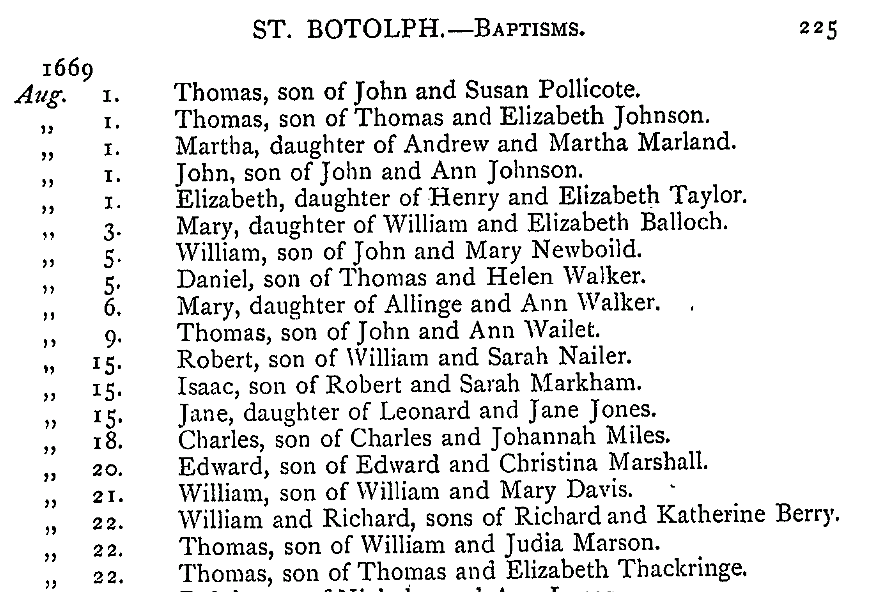
A possible Richard Berry ancestor in England — Berry twins born on August 22, 1669. This Richard Berry would be about four generations before our Richard Berry was born.
Robert and Elizabeth had ten children, all born in Orange County, North Carolina, between about 1760 and 1776. Below you will find what is known about each child. Children with more detailed records have their own pages, look for the arrow (→) next to their name.
First married George Waggoner c. 1775 in Orange County. George was the son of Henry Waggoner. George was mortally wounded in the Battle of Guilford Courthouse and died about a month later in 1781. They had 2 children. Mary married second James Kemp/Camp about December 1781 in Orange County. They had 5 children: John Camp (b. c. 1783), Sarah Camp Humphries (b. November 9, 1785), Robert Berry Camp (b. c. 1787), Stirling Camp (b. October 22, 1793), and Joseph Camp (b. c. 1795). Mary Berry Camp died in South Carolina before 1800.
Born c. 1762, Orange County, NC — Died after 1840, Fayette County, Berry, Alabama
Married Mary Waggoner c. 1784 in Orange County, NC. Mary was the daughter of Henry Waggoner. They had 6 children: Catherine Berry Pickle (b. October 1785), George Berry (b. c. 1790), John Berry, Henry G. Berry (b. 1794, d. December 26, 1866, Drew, Arkansas), Thompson Berry (b. December 18, 1801, d. January 8, 1871, Fayette County, AL), and David Middleton Berry (b. April 14, 1805, d. May 7, 1880, Fayette County, AL).
Born c. 1764, Orange County, NC — Died 1804, Jackson County, GA
Married Martha Stepp on September 16, 1793, in Person County, NC. They had 5 children: Polly Berry, Betsie Berry, Joshua Berry (b. 1797), Robert Berry (b. 1798), and William Berry (b. 1802).
Born c. 1769, Orange County, NC — Died October 8, 1838, Orange County, NC
Married Nancy Ellison on January 28, 1792. Nancy was born c. 1775, daughter of John Ellison, and died after 1850 in Orange County, NC. They had 9 children: Robert Berry, Dicey Berry, James Berry, Joshua Berry Jr., Delilah Berry, Lewis Berry, Nancy Berry, Charlotte Berry, and Eli Berry.
Born c. 1770, Orange County, NC — Died c. 1815, Person County, NC
Never married. Had a daughter Mary Berry (b. c. 1792) by William Riley. Robert Berry allowed Elizabeth to live in his home until her daughter Mary was grown and married. A bastardy bond was placed on William Riley.
Born c. 1772, Orange County, NC — Died before 1812, Tennessee
Married Sarah Cate on August 12, 1800, in Orange County, NC. Sarah was born December 27, 1782, daughter of William and Elizabeth Messersmith Cate, and died March 7, 1875, in Wayne County, Tennessee. They had 2 children: David Berry and Eleanor Berry Reed. Thomas died while searching for land in the west. There is a folklore story by the descendants who live in Tennessee today that Thomas was killed by Indians while searching for land.
Born c. 1774, Orange County, NC — Died after 1830, Fayette County, Georgia
Married Mary Blalock on February 27, 1797, in Orange County, NC. Mary was born c. 1772 in Orange County. They had 11 children, all born in North Carolina before the family moved to Georgia: Elizabeth Leathers Berry, Sarah "Sally" Berry, Winifred Berry, David J. Berry Jr., Mary Berry, Henry Berry, George N. Berry, Robert Berry, William G. Berry, Thomas Berry, and Joshua M. Berry. David was the last of Robert and Elizabeth Cate Berry's children to leave home.
Born c. 1775, Orange County, NC — Died 1860, Franklin County, TN
Married Hannah Cate on August 11, 1799, in Orange County, NC. Hannah was born 1770 in Person County, NC, daughter of William and Elizabeth Messersmith Cate, and died February 25, 1858, in Orange County, NC. They had 3 children: William Clarence Berry (b. October 17, 1803), Robert C. Berry (b. April 14, 1805), and Thomas Person Berry (b. June 1, 1808, d. April 30, 1884, Orange County, NC).
Born 1776, Orange County, NC — Died 1855, Orange County, NC
Had a daughter Mary Ashley Berry by Fanny Ashley, but they were never married. This is known because Fanny Ashley was living with her daughter Mary Ashley Berry King in 1850. Henry inherited the Plantation Home and left it to his daughter Mary Ashley Berry and her husband Thomas King in 1855.
On January 16, 1815, a power of attorney was drawn in Jackson County, Georgia, giving power of attorney to Joseph Camp. The document was signed by sons John Camp, Robert Camp, and Starling Camp, and son-in-law Shadrack Humphries, the husband of Sarah Humphries, formerly Sarah Camp. These were the grandchildren of Robert and Elizabeth Cate Berry through their daughter Mary Berry Camp.
Source: NC Archives (Orange County NC Powers of Attorney 1781–1909, CR.073.928.5)
The back of the power of attorney document reads: “I sign over the written power of attorney to Henry Berry, December 29th, 1816. Witnessed by Joseph Camp and Thomas Rountree.”
Robert Berry appeared on the Orange County, North Carolina, tax list in 1755 and in the census in 1790, 1800, and 1810. He died in 1814 and was buried at the Fiddleton Cemetery.
1755 — Robert Berry listed on the Orange County, North Carolina, Tax List
1790 — Robert Berry Sr. listed in Orange County, North Carolina Census
1800 — Robert Berry listed in Orange County, North Carolina Census
1810 — Robert Berry listed in Orange County, North Carolina Census
Robert was not in a census after 1810. The two neighbors who signed his 1812 will were J. (Joseph) Rountree and William Roberson. Robert Berry died in 1814 and was buried at the Fiddleton Cemetery.