Chapter V#
Wagons South — Alabama — “Heart of Dixie”#
A. State of Alabama created December 14, 1819#
Some native-born Americans from the 13 Original Colonies trickled into Alabama while the British ruled here. After the Revolutionary War ended, the trickle became an increasing stream…A boundary dispute with Spain involving Alabama was settled by the Treaty of San Lorenzo 1795. (I; p.123)
Many pioneer settlers had stayed out of Alabama because of the Indians. However, the Treaty of Fort Jackson 1814. ended the “War of the Red Sticks”. By this treaty, the Indians ceded much of their land to the White Settlers. By the time Alabama became a state on December 14, 1819, the Indians had ceded most of their land to the White Man, never to have it returned. (I; p.143)
With the opening of the Indian lands, the flow of settlers into Alabama became a flood. (The BERRY surname became part of this migration) Many left the Carolinas in the early 1800’s and headed for the South & West. These pioneers traveled over Indian trails & plank roads, across covered bridges, and on ferries. Some traveled by flatboats, keelboats, steamboats, & puffing locomotives. Some of the wealthy started plantations while the yeomen farmers started small farms. Some humble pioneers traveled on horses; on wagons, & on ox carts. They traveled in groups with family members & in wagon trains with other families. (I; pp.147-148)
The BERRY pioneer settlers certainly lived in log cabins, since there were not many sawmills close by. The log cabins were brought into Alabama by American settlers who had been living in them in the Old English Colonies off the Atlantic Seaboard. The first of the American log cabins were in Delaware, to which colony this type of dwelling had been brought by the Swedes. In Alabama, and all over the frontier to the North, the log cabin suited the needs of the (BERRY) settlers. The raw materials were standing close at hand, and anyone with a will to work could soon have a stout home built of horizontal logs. (I; p.119)
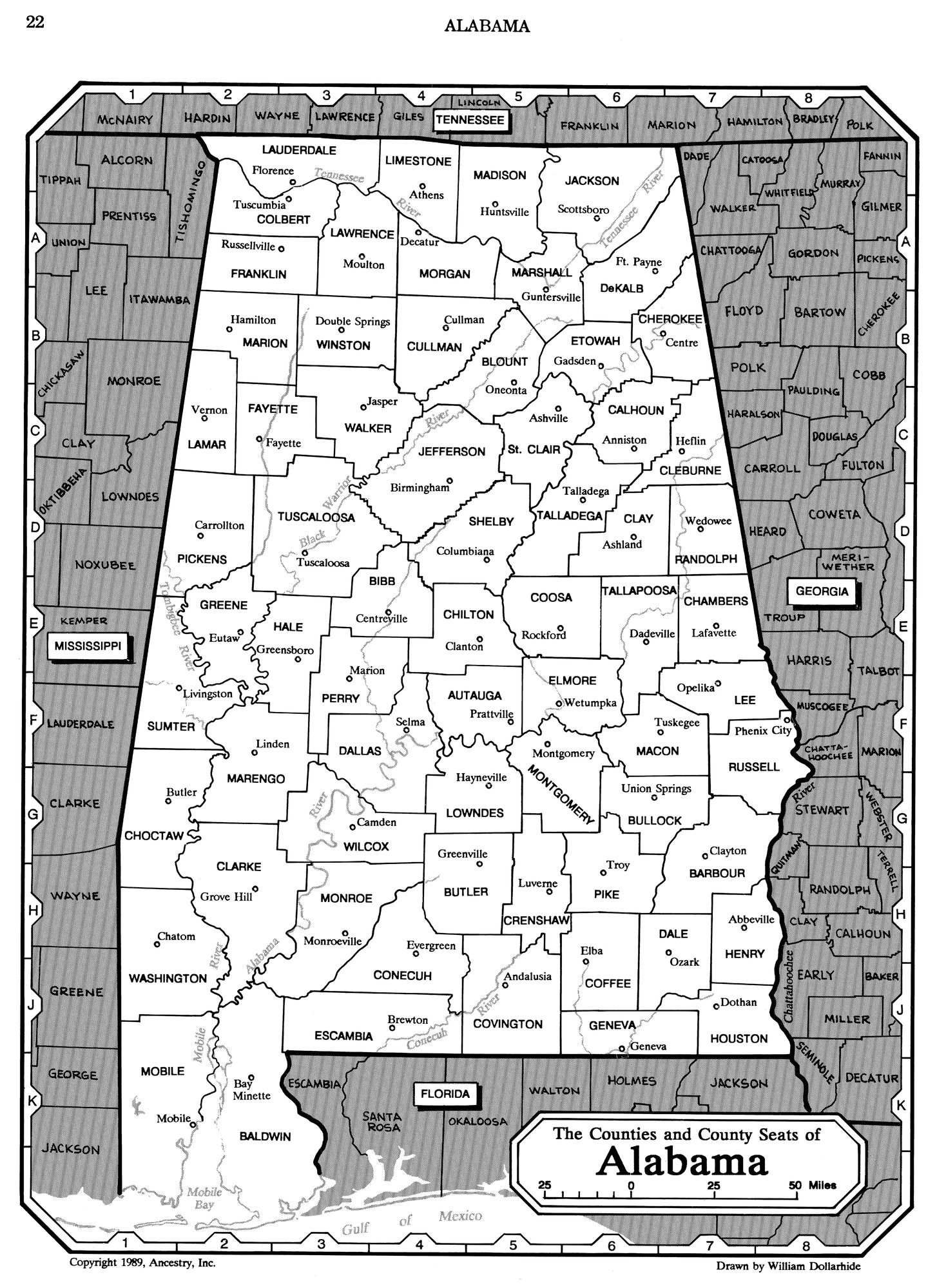
A Map Showing: Alabama Counties, County Seats, State Capitols, and River Systems
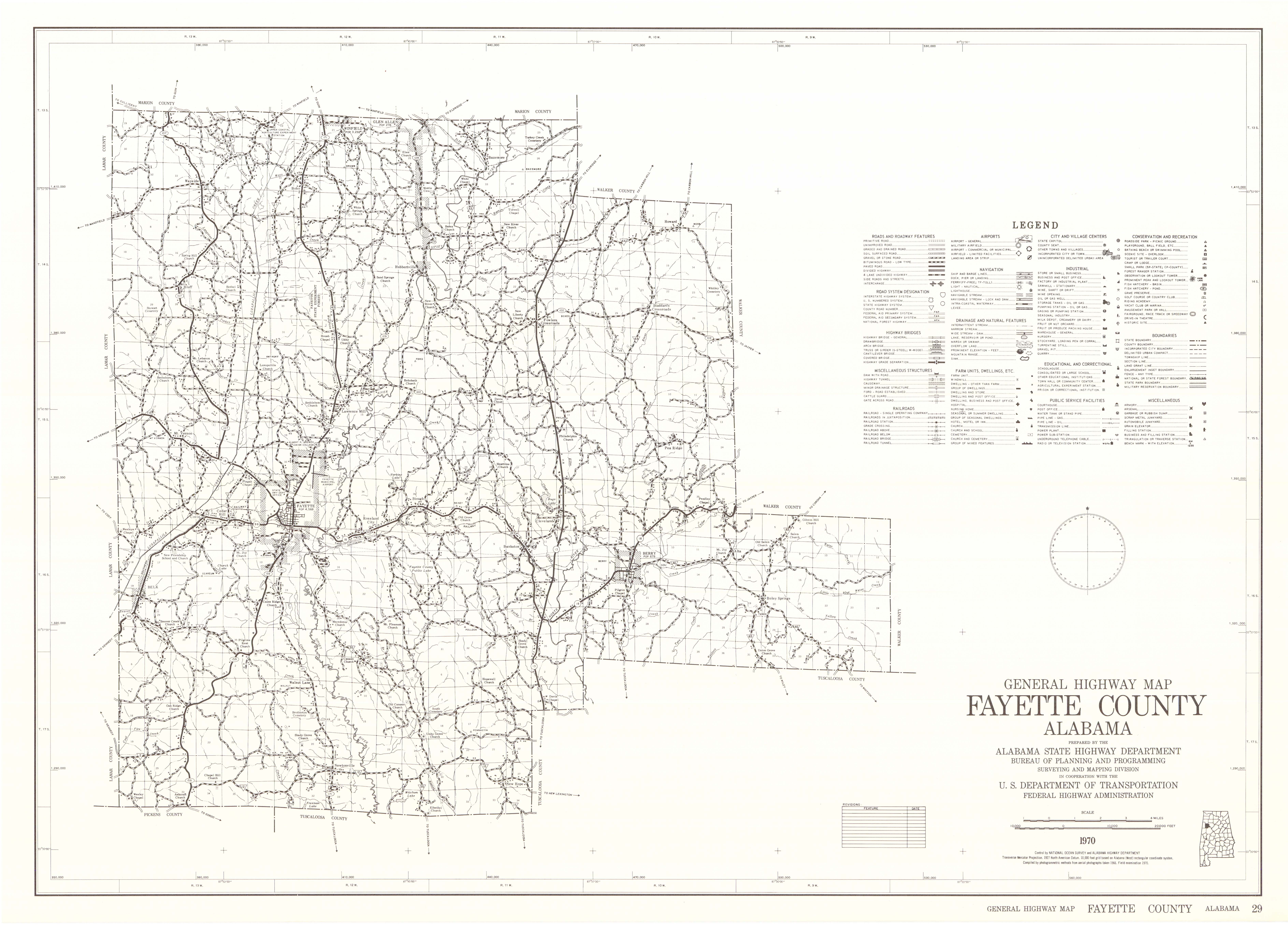
General Highway Map, Fayette County, Alabama — Alabama State Highway Department, Bureau of Planning and Programming; U.S. Department of Transportation, Federal Highway Administration
B. County of Fayette created — December 20, 1824#
The first people to set foot in the primeval forest of an area later to be named Fayette County, Alabama, were roving bands of Indians. The last of these were the Creeks, Chickasaws & Choctaws. A wealth of game & fish was to be had. These Indians left as evidence of their presence artifacts of various kinds, few mounds, and a few Indian graves. Arrow heads are yet unearthed on farms along the Luxapallila River. (XV; p.1)
Located in the Northwest part of Alabama, the land in Fayette County ranges from level to undulating, to steeply rolling & hilly. Within the limits of the Appalachian Mountain & Plateau Province and the Atlantic & Gulf Coastal Plain Province, the soil is derived from underlying sandstones & shales of the Carboniferous Age. Brown loam with red clay subsoil of above average fertility is prevailing.
A ridge running North & South known as the Byler Ridge, creates a divided drainage system in the county. Lands West of the ridge drain into the Luxapallila & Sipsey Rivers; while lands on the East drain into the North River and on to the Warrior River.
Originally the area of the county was 700 square miles but at later dates the boundary was changed…The last change in boundary took place in 1867 in which land was cut off to form Jones County, later called Sanford; now named Lamar County. The area of Fayette County today is 463 square miles. (XV; p.5)
To this setting in the hills of Alabama, came a wagon train of 100 or more wagons in the year 1818 and rolled to a stop in what is now Fayette County. Family surnames within this wagon train were at least the following: BERRY, Gardner, Kizziah, Strong, Cole, Stough & Crowley. (III; p.269)
On December 20, 1824, there being the required number of inhabitants to qualify, an act of the Alabama Legislature created Fayette County, in honor of LaFayette, the great French General of Revolutionary War fame. (XV; p.1)